Quote the job from the take-off — not from the last quote.
Costing, take-off, BOM, drawing register, documentation pack: in most fabrication firms these are five copies of the same information, maintained by hand. We build systems where the job is entered once and every document downstream is generated.
Industry · Metal fabrication & structural steel
Same method underneath. Your vocabulary on top.
 Illustrative
The work you recognise
Six ways a fabrication job leaks hours.
Estimating waits on one person
The costing workbook has years of rates buried in it, and only the senior estimator trusts himself to touch it.
Rev C starts the quote again
The client moves a nozzle; someone re-measures, re-prices and re-types a document that was nearly finished.
Take-off is typed four times
Measured on the drawing, typed into the costing sheet, again into the BOM, again into the purchase requisition.
The drawing register is a folder
Final_rev2_LATEST.dwg. Which revision actually went to the workshop is a matter of memory.
Doc packs assembled the night before
Mill certs, WPS references, test reports — collected from six folders every time the client asks for the dossier.
Job status lives on the floor
Whether the job is cut, welded or at painting is known by walking over and asking the supervisor.
Proof, not promise
We built the estimating engine first — for the work we came from.
Valtrin's founder spent years doing fabrication estimating before Valtrin existed, so the first tool we built was the one that job needed. Enter the project parameters once and the engine produces the material cost build-up, weight, BOM, labour costing and the quotation document — with revision comparison that shows exactly what changed between Rev B and Rev C.
Every number comes from deterministic code — the same inputs always produce the same price — and the engine is validated against completed jobs with known results. It exists, it runs, and we can demonstrate it on a call.
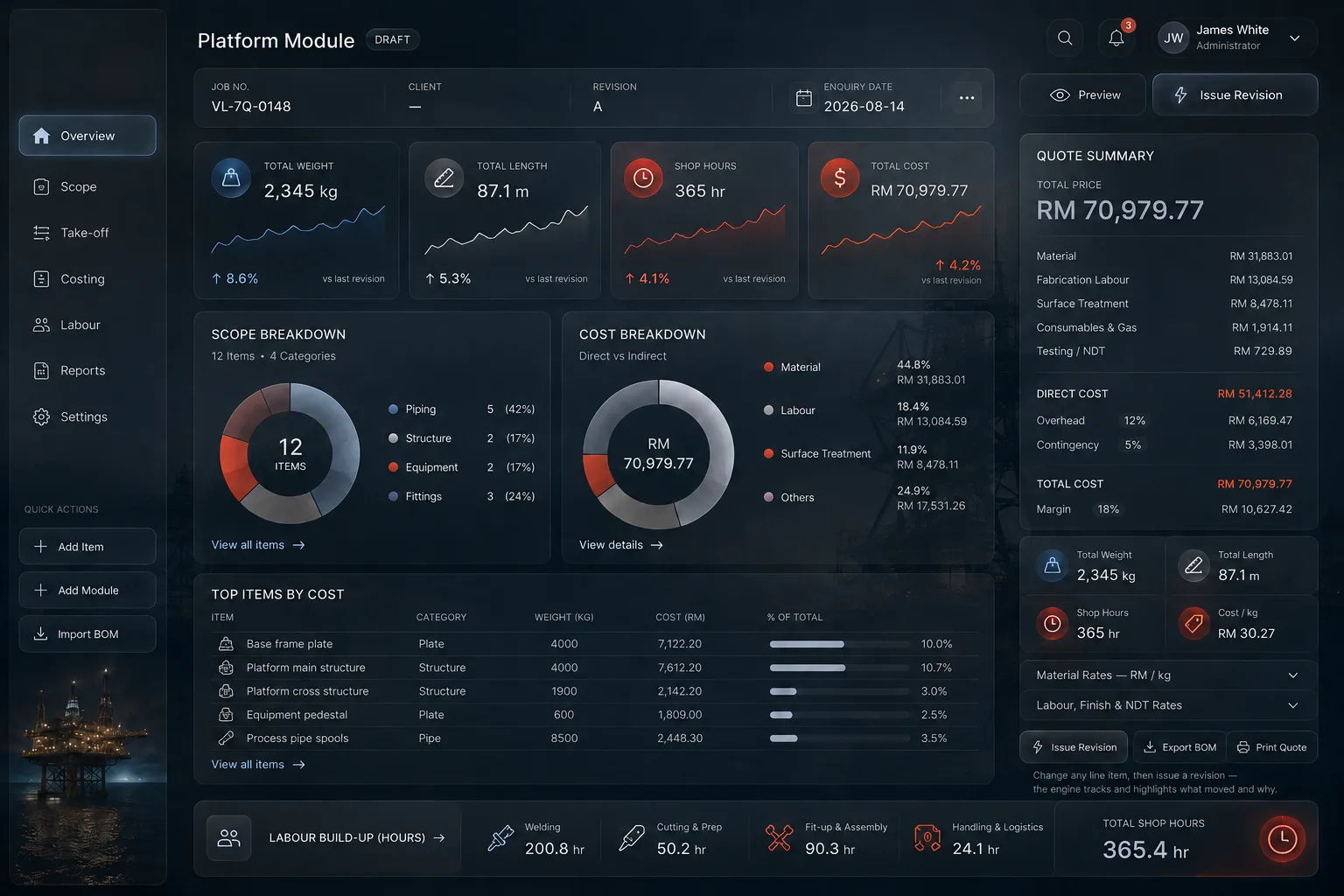
The shape of the system
One entry at the drawing. Everything downstream generated.
Same method underneath. Your vocabulary on top.
Same method underneath. Your vocabulary on top.
What the three levels look like here.
Estimating & Engineering Software
Quoted per project
One estimator, one estimating tool. Drawing in; weights, BOM, labour and a quotation on your letterhead out. Proved against ten jobs you have already priced, to the kilogram.
Estimating & Engineering Software
Quoted per project
The whole estimating team on it, with a signing limit. Juniors price, you approve anything under your floor margin, and the tool reads job costs from the accounting system you already run.
Estimating & Engineering Software
Quoted per project
Your main contractors log in to their own jobs, drawings and revisions — REV B to REV C with the change shown — instead of phoning the workshop to ask.
If the bottleneck is the shop floor and not the office, start somewhere else entirely: the Machines & Equipment line assessment is one day timing the actual bench and an honest verdict on whether a machine pays at all, quoted for your job. Any commission we earn from a manufacturer is put in writing before you commit.
Where to go next
Three ways in, depending on the bottleneck.
Estimating & Engineering Software
Estimating engines, take-off and BOM tools, drawing registers — one tool per job, built to your costing method and validated against jobs you've already priced. The Essential level, quoted per project after scoping.
Engineering Workflow Automation
Documentation packs assembled by the system, transmittals logged as they happen, quotation follow-ups queued instead of remembered. One workflow, quoted per project after scoping.
Client Portals for Engineering Firms
Production tracking the whole workshop can see, and a status window for the client instead of a phone call to the floor. The Standard level, quoted per project after scoping.
Start here
Bring us the job you quoted twice.
Send one drawing package and the quotation it produced. We'll walk the path the numbers took from take-off to document — and tell you honestly whether a system would pay for itself.
calvin@valtrintechnologies.com
+60 11-1122 6683 · Kuala Lumpur, Malaysia
Not ready to commit to a build? Start with the free 30-minute review. If the job is worth doing, the Diagnostic and Blueprint is RM 2,500, credited in full against the build — the job costed and the solution specified in writing, yours to keep whether or not you build with us.
No technical brief needed — describe how a quotation gets made in your office today, start to finish.